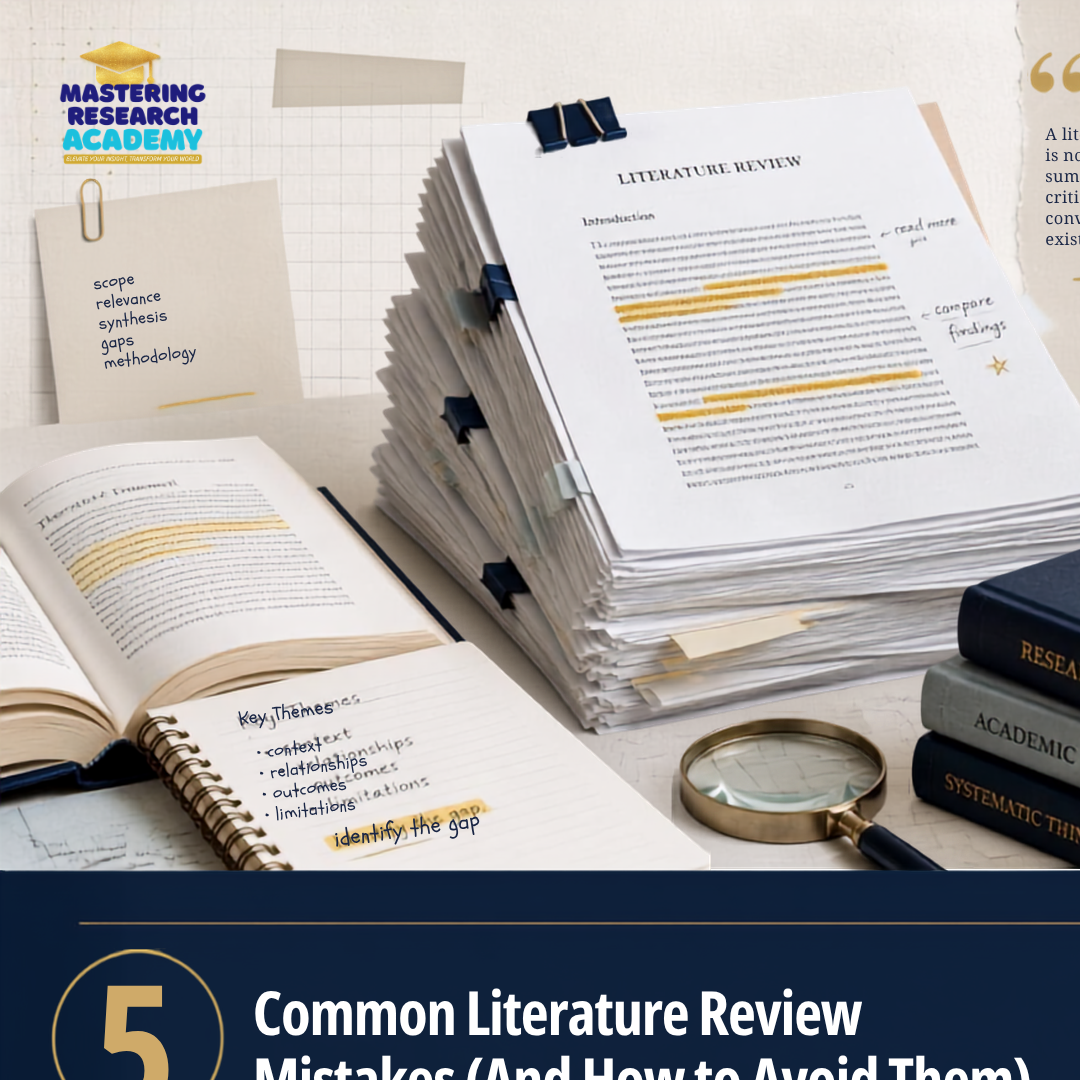
Struggling with your literature review? You’re not alone. Learn the most common pitfalls that trip up graduate students and researchers—and how to sidestep them.
If you’ve ever felt overwhelmed by the literature review process, you’re in good company. From PhD candidates to early-career researchers, many brilliant minds struggle with this critical component of academic work. The good news? Most literature review problems stem from a handful of common mistakes—and once you know what they are, you can avoid them entirely.
In this guide, we’ll walk through the five most frequent literature review errors and give you actionable strategies to overcome each one.
Mistake #1: Starting Without a Clear Research Question
The Problem:
Too many researchers dive into reading papers without first defining what they’re looking for. This leads to: – Wasted time reading irrelevant studies – A scattered, unfocused literature review – Difficulty synthesizing findings – Unclear contribution to the field
The Solution:
Define your research question BEFORE you begin reading.
Your research question acts as a filter, helping you determine which sources are relevant and which aren’t. A well-defined question should be: – Specific: Not “What is climate change?” but “How do urban green spaces impact local temperature regulation in tropical cities?” – Focused: Narrow enough to be answerable within your scope – Clear: Unambiguous terms that guide your search strategy
Action Step: Write your research question at the top of your literature review workspace. Before adding any source, ask yourself: “Does this directly address my research question?”
Mistake #2: Reading Everything (Instead of Being Strategic)
The Problem:
Many researchers fall into the “completeness trap”—believing they must read every single paper ever written on their topic. This results in: – Analysis paralysis – Months (or years) stuck in the reading phase – Inability to move forward with research – Burnout and frustration
The Solution:
Adopt a strategic reading approach.
Not all sources deserve the same level of attention. Use a tiered reading strategy:
Tier 1 – Skim (5 minutes): Read abstract, introduction, and conclusion – Decide: Is this relevant to my research question? – Keep or discard
Tier 2 – Selective Reading (15-30 minutes): Read sections relevant to your specific focus – Extract key arguments, methods, and findings – Note how it relates to your work
Tier 3 – Deep Reading (1-2 hours): Reserved for seminal works and highly relevant studies – Critical analysis of methodology and conclusions – Detailed notes and synthesis
Action Step: For every paper you encounter, start with Tier 1. Only promote papers to Tier 2 or 3 if they pass the relevance test.
Mistake #3: Treating Your Literature Review as an Annotated Bibliography
The Problem:
Many literature reviews read like this: “Smith (2020) found X. Jones (2021) found Y. Brown (2022) found Z.”
This is a list, not a review. It: Lacks synthesis and critical analysis – Doesn’t show relationships between studies – Fails to identify gaps or contradictions – Doesn’t position your research contribution
The Solution:
Synthesize, don’t summarize.
A strong literature review: Groups studies thematically rather than chronologically – Identifies patterns, trends, and contradictions across the literature – Critically evaluates methodologies and conclusions – Highlights gaps your research will address – Tells a story that leads to your research question
Example of Good Synthesis: “While early studies on urban green spaces focused primarily on biodiversity (Smith, 2018; Jones, 2019), recent research has shifted toward ecosystem services, particularly temperature regulation (Brown, 2021; Lee, 2022). However, most of this work has been conducted in temperate climates, leaving tropical urban contexts underexplored—a gap this study addresses.”
Action Step: Organize your literature review by themes or concepts, not by individual author. Ask: “What do these studies collectively tell us? Where do they disagree? What’s missing?”
Mistake #4: Ignoring the “So What?” Question
The Problem:
Researchers often forget to explain why each source matters. They include studies without clearly connecting them to: Their research question – The broader theoretical framework – The gap they’re addressing – Their unique contribution
The Solution:
Always answer “So what?” for every source you include.
After presenting each study or group of studies, explicitly state: Relevance: Why does this matter for my research? – Implication: What does this mean for my field? – Connection: How does this relate to other studies I’ve discussed? – Gap identification: What does this study NOT address that I will?
Example: “Smith’s (2020) finding that green roofs reduce urban temperatures by 2-3°C is significant because it provides a baseline for expected cooling effects. However, Smith’s study was limited to temperate cities with moderate rainfall. This raises the question: Do green roofs provide similar benefits in tropical climates with high rainfall and humidity? This study addresses that gap.”Action Step: At the end of each paragraph in your literature review, add a sentence that answers “So what?” Delete any sources where you can’t answer this question.
Mistake #5: Conducting a One-Time Literature Search
The Problem:
Many researchers search for literature once at the beginning of their project – Don’t revisit or update their review – Miss important new publications – Have outdated references by the time they submit
The academic landscape evolves constantly. A literature review from 18 months ago may already be outdated.
The Solution:
Treat your literature review as an ongoing process.
Implement a continuous review strategy:
Monthly Check-ins: Set up Google Scholar alerts for key terms – Check new issues of top journals in your field – Re-run your database searches quarterly – Follow key researchers on ResearchGate or Academia.edu
Version Control: Date your literature review drafts – Keep a “recently added” section for new sources – Note when you last updated each section – Track emerging trends and debates
Integration Timeline: Months 1-3: Initial comprehensive review – Months 4-12: Monthly updates and targeted searches – Final 2 months: Intensive update before submission – Just before submission: One last check for very recent publications
Action Step: Set a recurring monthly calendar reminder to spend 2-3 hours updating your literature review. This small investment prevents the need for massive revision work later.
Bonus Tip: Don’t Go It Alone
One of the biggest mistakes? Trying to master the literature review process in isolation. The most successful researchers: Seek feedback from advisors and peers – Attend workshops and webinars on literature review methods – Join writing groups for accountability – Learn systematic review techniques – Use citation management tools effectively.
Ready to Master Your Literature Review?
If you’ve recognized yourself in any of these mistakes—don’t worry. Every researcher has been there. The key is learning the right strategies to move forward efficiently and effectively.
Want to dive deeper? Join Prof. Iyabode Nwabueze for a comprehensive webinar on Mastering the Literature Review on August 25, 2026. You’ll learn:
✅ How to develop a systematic search strategy
✅ Advanced synthesis techniques that go beyond summarizing
✅ Critical analysis frameworks for evaluating sources
✅ Time-saving tools and workflows
✅ How to identify and articulate research gaps
Register for the Free Webinar Here →
Space is limited, and this hands-on session will transform how you approach literature reviews. Don’t let these common mistakes hold back your research any longer.
Key Takeaways
- Define your research question first to guide your entire review process
- Read strategically, not exhaustively—use a tiered approach
- Synthesize and analyze, don’t just list and summarize
- Always explain the “So what?” for every source you include
- Update your review continuously throughout your research journey
By avoiding these five mistakes, you’ll save countless hours, produce a stronger literature review, and position your research for success.
What literature review challenges are you currently facing? Share in the comments below, or join us at the webinar to get your questions answered!
About the Facilitator:
Prof. Iyabode Nwabueze is a professor of English (Language). She is an expert in research methodology, with years of experience helping graduate students and researchers master the literature review process. She has guided many of her students through successful research papers, dissertations, and theses.
Keywords: literature review mistakes, common research errors, how to write a literature review, thesis literature review, dissertation literature review, research methodology, academic writing tips, graduate student tips


Leave a Reply